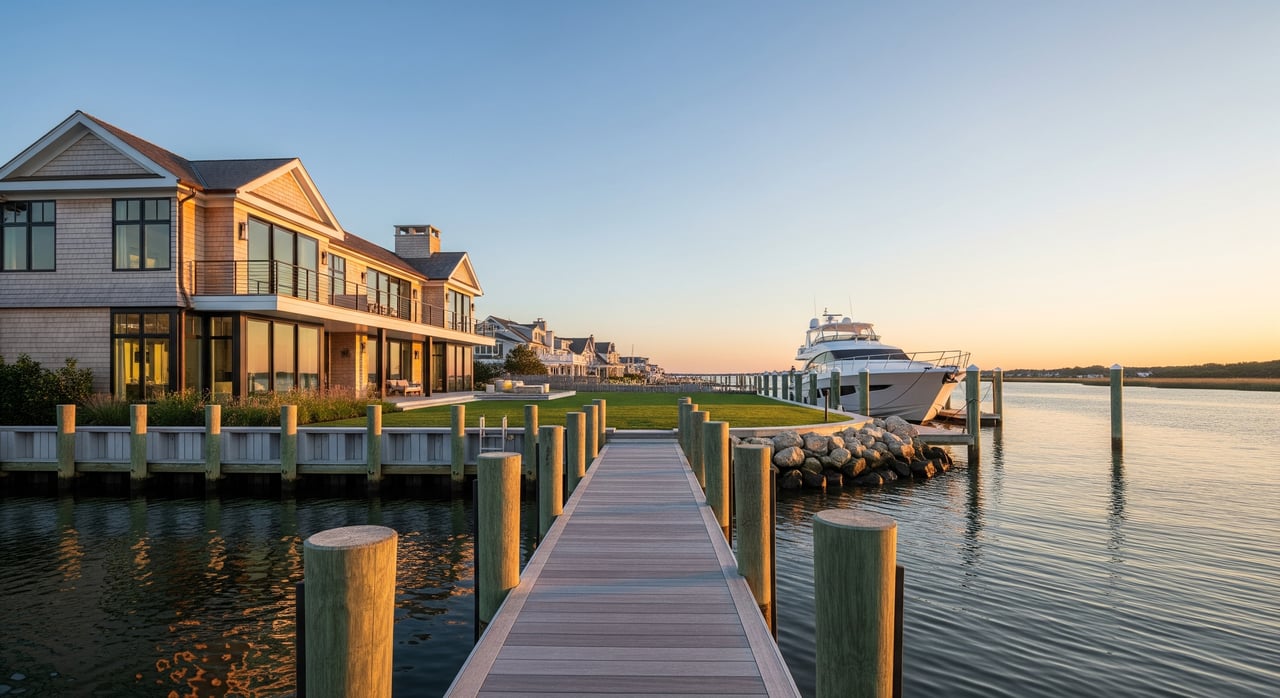
Eyeing a waterfront home in Oceanport and wondering if your mortgage will be considered “jumbo”? You are not alone. With many shoreline properties priced at or above a million dollars, the loan amount you need can change your path to approval. This guide breaks down jumbo loans in Monmouth County, what lenders expect on waterfront homes, and how to prepare a clean, confident file. Let’s dive in.
What a jumbo loan means in Oceanport
A jumbo loan is any mortgage that exceeds the conforming loan limit set by the Federal Housing Finance Agency for your county. For 2025, the national baseline for a one‑unit home is $806,500, and the high‑cost ceiling is $1,209,750, which applies to higher‑priced areas. Monmouth County uses the high‑cost ceiling, so any loan amount above $1,209,750 is considered a jumbo locally. You can confirm national and county details in the FHFA’s announcements and county lists for 2025 limits.
- See FHFA’s 2025 overview of baseline and high‑cost limits for context on how limits are set and updated each year: FHFA conforming loan limit announcement.
- Verify county assignments and limits using FHFA’s downloadable county tables: FHFA county loan limits tool.
Why this matters for waterfront buyers
Oceanport’s waterfront and newer luxury homes often list near or above the county limit, which can push your loan amount into jumbo territory if you plan a lower down payment. Local snapshots show Oceanport home values spanning the mid‑six‑figure to low‑seven‑figure range, with taxes and pricing that vary by location and features near the water. Use current comps to check where your target property sits. For neighborhood tax and value context, review a local data snapshot for Oceanport: Oceanport market and tax trends.
How jumbo loans differ
Jumbo loans do not follow a single set of agency rules. Lenders set their own guidelines, which are usually more conservative than conforming standards. Expect stronger borrower profiles and fuller documentation.
Credit, down payment, and reserves
- Credit: Many lenders look for strong credit on jumbo files. A higher score can improve terms.
- Down payment: Typical jumbo loan‑to‑value ratios are more conservative, with 20 percent down common. See a lender perspective on LTV for large balances: jumbo and super‑jumbo LTV overview.
- DTI and reserves: Lenders often target lower debt‑to‑income ratios and require sizable cash reserves. Expect full documentation and verification of assets and income. For an at‑a‑glance look at common jumbo expectations, review this guide: what to expect with jumbo underwriting.
Appraisals on waterfront properties
Waterfront homes are specialized for valuation. Comparable sales need to match water access, dock or bulkhead features, and condition. For higher loan amounts, lenders may require extra valuation steps, such as a field review or a second appraisal. Learn why specialty comps and timelines matter here: waterfront considerations in jumbo appraisals.
Flood zones and insurance
If a property is in a Special Flood Hazard Area, lenders require flood insurance. Your premium depends on the FEMA flood zone, elevation relative to base flood elevation, foundation type, and the structure’s replacement cost. Always factor flood coverage in your monthly and annual budget. For maps and definitions, start with FEMA’s resources: FEMA coastal flood maps and insurance basics.
Private flood insurance has expanded in recent years, offering alternatives to NFIP policies in some cases. Pricing and coverage vary by carrier, and lender acceptance of private flood policies should be confirmed early. For market context on private flood growth, see this reporting: private flood insurance expansion overview.
Permits, docks, and title items (NJ specifics)
New or substantial work on docks, bulkheads, and other shoreline improvements in New Jersey often requires permits under state coastal rules. Buyers should review any recent permits, engineering reports, and repair history before closing, especially on larger loans. Learn more about the regulatory framework guiding coastal development and waterfront work: NJ coastal and waterfront permitting context.
Beyond permits, confirm title details related to riparian rights, easements, shared structures, and any local maintenance obligations for bulkheads or access points. Order a current survey and share it with your lender early.
Total cost picture for Oceanport waterfront
- Property taxes: Monmouth County taxes are above the national average, and Oceanport tax bills typically land in the mid‑thousands to low five figures based on value. Review current assessments and recent bills for accuracy using a local snapshot: Oceanport market and tax trends.
- Insurance: Budget for homeowners and, if needed, flood insurance as separate policies. Flood premiums can materially affect affordability depending on zone and elevation. See FEMA’s resources: FEMA coastal flood maps and insurance basics.
- Waterfront upkeep: Docks, pilings, bulkheads, and erosion control are recurring line items. Plan for periodic inspections and reserves for maintenance.
Two quick scenarios (illustrative)
These simple examples show how the conforming limit can shape your path:
- Example 1: Purchase price $1,600,000 with 25 percent down equals a $1,200,000 loan amount. That falls at or below Monmouth County’s conforming ceiling of $1,209,750, so you may pursue conforming financing if you qualify.
- Example 2: Purchase price $1,600,000 with 20 percent down equals a $1,280,000 loan amount. That exceeds $1,209,750, so you would need a jumbo loan.
Always confirm exact loan limits and your qualifying details with your lender using FHFA’s references: 2025 FHFA announcement and county loan limits tool.
Step‑by‑step plan to get ready
- Get pre‑qualified with a lender experienced in jumbo and waterfront files. Ask about credit, LTV, reserves, appraisal steps, and flood policy acceptance. Start here: what to expect with jumbo underwriting.
- Confirm whether your target loan amount exceeds the local limit. Check current county limits: FHFA county loan limits tool.
- Order a flood zone determination and request any existing elevation certificate. If in an AE or VE zone, gather quotes for NFIP and private flood to compare coverage and cost: FEMA coastal flood maps and insurance basics.
- Commission a current survey and review title for riparian rights, easements, and bulkhead or dock ownership. Share early with your lender.
- Plan for a specialty appraisal and allow extra time for waterfront comps. If your loan amount is large, budget for the possibility of a second valuation step: waterfront considerations in jumbo appraisals.
- Organize full documentation: two years of tax returns, W‑2s or P&Ls, bank and investment statements for reserves, and clear paper trails for large deposits.
Your next move
A strong jumbo file begins with early planning around limits, flood risk, valuation, and documentation. With the right prep, you can secure a loan that fits both your Oceanport lifestyle and your balance sheet. If you want a local, finance‑savvy partner to help you target the right properties and navigate lender expectations, connect with the Suzanne Veninata Team for guidance tailored to Oceanport and the Monmouth County waterfront.
FAQs
What loan amount counts as a jumbo in Monmouth County for 2025?
- Any first‑lien one‑unit mortgage with a loan amount above $1,209,750 exceeds the local conforming ceiling and is considered a jumbo.
Do jumbo mortgage rates always run higher than conforming rates?
- Not always. Rates vary by lender and borrower profile, and strong credit, lower LTV, and healthy reserves can produce competitive jumbo pricing.
How much down payment do I typically need for a jumbo loan?
- Many lenders cap jumbo LTV at 80 percent or lower, so 20 percent down is common. Some allow higher LTV for very strong borrowers, and second homes often require more down.
Do I need flood insurance to finance an Oceanport waterfront home?
- If the home is in a Special Flood Hazard Area, most lenders require flood insurance in addition to standard homeowners coverage.
What makes a waterfront appraisal different from a typical appraisal?
- Appraisers prioritize true waterfront comparables and adjust for features like docks, bulkheads, and water depth. Higher loan amounts can trigger additional review steps.
Are there special permits for docks or bulkheads in New Jersey?
- Yes. Many new or substantial repairs on docks, bulkheads, and similar structures require permits under New Jersey’s coastal rules, so review history and consult qualified professionals early.